Thursday, 13 August 2009

Brazil: BM&FBovespa on course for recovery

BM&FBovespa is on the way to regaining the trading volumes seen at the Brazilian futures and equities exchange before the global economic crisis hit, according to analysts.

Presenting second-quarter results on Wednesday, Edemir Pinto, chief executive, said the exchange was “recovering very well”.

Operating income was R$420.6m ($229.3m) in the second quarter, a fall of nearly 15 per cent year on year but an increase of almost 20 per cent from the previous quarter.

Net profit was R$188.1m, nearly 14 per cent up on the R$165.2m reported in the second quarter last year, mainly owing to cost savings including a reduction in staff by almost a quarter.

However, profits were hit by what the company admitted had been the surprising implementation in Brazil of international accounting practices. This resulted in a negative impact of R$137.2m on the company’s net profits but with no impact on its cash position. Setting this effect aside, adjusted profit was R$325.4m during the quarter, up by 32 per cent from a year earlier.

The BM&FBovespa was formed in May 2008 through the merger of the São Paulo derivatives and equities exchanges. It has sought international expansion via strategic alliances, most notably with CME Group of Chicago, which holds 4.9 per cent of its equity. This alliance has been an important source of business growth as participants on the BM&FBovespa and the CME can trade instruments on the two exchanges directly.

Bernardo Mariano of Equity Research Desk, a New York research house specialising in equities and derivatives exchanges, said although volumes had picked up only quite slowly, the exchange had had its best quarter in terms of inflows from overseas since Brazil was given investment grade status by leading ratings agencies in April and May last year.

He said those inflows could be expected to continue as investors saw in Brazil a natural hedge against rising inflation around the world.

“There are two exchanges in the world that provide a hedge against inflation, the CME and the BM&FBovespa,” he said. “That’s because 80 per cent of the BM&FBovespa’s capitalisation is related to commodities.”

Mr Mariano said some 30-50 per cent of daily trading in Brazilian derivatives currently took place over the counter in the US. By introducing new electronic trading technology, allowing such traders direct access to the BM&FBovespa from overseas, the Brazilian exchange was moving to capture that market.

Mr Pinto said information technology being introduced this year would allow the exchange to capture such business within about six months. The BM&FBovespa has already introduced so-called direct market access systems in which foreign clients install their own servers inside the exchange.

Source: Financial Time,12.08.2009

Unemployment: Historical Chart Sends Scary Message

No doubt, you’ve probably seen a chart of the unemployment rate recently. And you know about the surprise dip in last month’s unemployment rate.

By the way, that reduction has been roundly dismissed as a statistical mirage because more likely than not, it was caused by people who gave up looking for a job, rather than people actually finding a job.

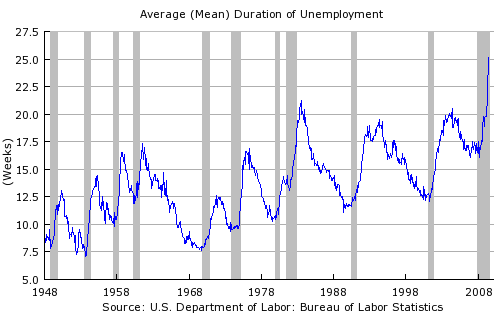
If you think the level of unemployment is alarming, you’ll find the chart of the average duration of unemployment in weeks downright frightening:
average mean duration of unemployment
Source: St. Louis Fed

The shaded bars, of course, represent instances and durations of recessions as determined by the NBER.

Since the Department of Labor started collecting data for this statistic in the late 1940’s, we haven’t seen unemployment last this long. The latest data is for July 2009 at 25.1 weeks - in other words, almost 6 months!

No wonder people are giving up looking for work. You would have to have the patience and fortitude of Job to persevere through such a harrowing episode. And remember, this is an average, so there are many who have been unemployed for much longer.

This means that the stock market recovery we’ve seen so far has not only been mostly a profitless, revenue-less one but also it is shaping up to be a jobless recovery. But then again, the stock market is famously supposed to be ahead of economic measures like unemployment.

Take the previous highest peak in the average duration of unemployment: July 1983 at 21.2 weeks. If we travel back in time to those days, it isn’t hard to imagine that we would be equally frightened at this statistic. However, thanks to hindsight we now know that by July 1983 the stock market had already bottomed and gone on to gain an astonishing 70% (for the Standard & Poor’s 500 index). So far, we’re only up about 45% since the March 2009 bottom - if it is indeed the floor.

So while the above chart may send a chill down everyone’s back about the health of the US economy, it doesn’t mean that the stock market is on borrowed time. More importantly, how can anyone look at it and still be worried about inflation?

Despite all the stimulus, the US economy is far, far away from reaching capacity and inciting inflation worries. I guess that is the narrow silver lining to this dark cloud.

Source: SeekingAlpha, 13.08.2009


Chi-X Global and SGX to launch first exchange-backed dark pool

Chi-X® Global Inc. (Chi-X) and Singapore Exchange Limited (SGX) have signed a Heads of Terms Agreement to develop and launch the first exchange-backed dark pool in the Asia-Pacific region. The non-displayed trading platform aims to initially offer block crossing facilities for equities listed on SGX, and on an offshore basis for the Australia, Hong Kong and Japan exchanges.

FiNETIK recommends

Chi-X seeks new business model for Asia

A project implementation team has been formed with the goal of commencing operations and trading in the first half of 2010. The joint venture, which will be equally owned by the two sponsors, intends to implement specific strategies to equip its dark pool with ample liquidity and attract new capital flows to the region.

The dark pool will operate with appropriate regulatory approvals and controls, reporting, settlement systems and compliance standards.

"Chi-X is delighted to work with a forward-looking and market-focused partner like SGX to launch and operate this dark pool, with the aim of creating the deepest and most attractive dark pool liquidity in the Asia-Pacific region," said John Lowrey, CEO of Chi-X Global. "Our experience has shown that users are looking for independent, genuinely neutral dark pools with high functionality and deep liquidity, and we believe that this joint venture will be able to deliver just that."

"SGX is pleased to offer Asia the first exchange-backed dark pool, which will complement exchange trading by reducing the market impact of large trades. We believe it will be an important block trading venue for Asian markets, attracting new participants and improving the trading environment in the region," said Gan Seow Ann, SGX Senior Executive Vice President and Head of Markets. "We are glad to have a strong partner in Chi-X, who shares with us common goals of being innovative and internationally oriented."

Chi-X subsidiary Chi-X Global Technology, LLC (Chi-Tech), a provider of trading infrastructure solutions to global market centers and participants, will provide the technology for the platform. Around the world, Chi-X technology is powering a number of alternative and incumbent trading venues that are providing savings for investors through reduced market impact and improved liquidity.

SGX-listed stocks will be cleared and settled through The Central Depository (Pte) Limited (CDP), SGX's securities clearing house and depository, via SGX's securities clearing members. The JV intends to appoint a pan-Asian central counterparty to clear other trades executed on the dark pool.

Source: Automated Trader, 12.08.2009

Tuesday, 11 August 2009

Bursa Malaysia and CME Group in derivatives partnership

In line with the Prime Minister of Malaysia, Dato' Sri Najib Tun Abdul Razak's acknowledgement on Bursa Malaysia Berhad's (Bursa Malaysia) cooperative efforts with CME Group Inc (CME Group) to develop a robust derivatives market, the two exchanges announced today that they are working towards a collaboration involving trade matching services, product licensing and minor cross-equity investments.

The CME Group equity stake will relate to Bursa Malaysia's derivatives business. Specific terms will be announced at a later date. Both parties announced that this initiative is subject to regulatory approval.

With this strategic partnership, CME Group will use Bursa Malaysia's RM-denominated CPO futures contract (FCPO) settlement prices, which will enable CME Group to develop a USD-denominated cash-settled CPO futures contract and its related options for listing on one of CME Group's US registered exchanges. This product is expected to be traded on CME Globex, which is CME Group's electronic trading platform.

Dato' Yusli Mohamed Yusoff, Chief Executive Officer of Bursa Malaysia, said, "The proposed collaboration is not only timely but also necessary as it would contribute to the overall growth of the Malaysian capital market. It is also aimed at globalising the Malaysian crude palm oil (CPO) futures market. Consequently, part of this proposed collaboration will enable Bursa Malaysia Derivatives to list its derivatives products on CME Globex. Through this collaboration, we expect the resulting expertise and knowledge transfer to further facilitate our goal for a robust derivatives exchange."

"This initiative, when implemented, will enable our customers from other markets to access Bursa Malaysia's derivatives markets and products on CME Globex, the leading and most widely distributed electronic trading platform in the world, further demonstrating our flexibility to operate in multiple jurisdictions for the benefit of customers worldwide," said Terry Duffy, Executive Chairman of CME Group.

"Our proposed strategic partnership with Bursa Malaysia will further enhance our globalisation efforts by facilitating our customers' efficient access to Bursa Malaysia's important markets," said Craig Donohue, Chief Executive Officer of CME Group. "This proposed partnership will allow us to continue to expand our transaction processing business opportunities, increase our presence in Asia, as well as help our Malaysian partners grow their business."

Source: CME 11.08.2009

Celent: More positive reviews for India shares

Celent is the latest to sing the praises of India's stock market.

The Indian equity markets are showing signs of recovery, according to Celent, a Boston-based financial research and consulting firm. Although India's equity market capitalisation is still some way off the 2007 high of $3.3 trillion, it is expected to exceed 2008 levels in 2009 at $1.9 trillion, the firm says in its latest report on India shares.

Celent is the latest to sing praises for India's stock market. Earlier this month, Credit Suisse unveiled a new target of 17,000 for India's Bombay Stock Exchange benchmark index (Sensex). In June, BNP Paribas recommended its clients to reduce their exposure to China, which it has lowered to neutral from overweight, and increase their allocations to India, where the bank remains overweight. BNP Paribas' own target for the Sensex is 16,500. The Sensex closed at 15,160.24 on Friday.

The key findings of the Celent report include:

India is one of the main emerging equity markets. The country's leading stock exchange, National Stock Exchange (NSE) is ranked third in terms of the number of equity trades of individual exchanges. The Bombay Stock Exchange (BSE) is also one of the leading exchanges worldwide, and the Indian market continues to hold further promise, as the economy is expected to grow 5-6% even in the current economic downturn.

The NSE is expected to overtake the Bombay Stock Exchange (BSE) in market capitalisation in 2009. Already far ahead in turnover, the NSE is expected to further its lead. It has already cornered the exchange-based debt markets and the equity derivatives business and become the exchange of choice in India.

The NSE is preferred by foreign institutional investors (FIIs), while retail investors, domestic brokers, and sub-brokers prefer the BSE. NSE turnover is two times that of the BSE because FIIs hold on to shares for a shorter period of time than their local counterparts.

India's debt market is underdeveloped. In spite of growth, the Indian corporate debt market is far behind developed and emerging economies worldwide. At an expected turnover value of $70 billion in 2009, it is equal to less than 10% of the government debt market.

In the equity derivatives market, volatility has meant that the investors prefer to trade more in index derivatives because they are far more liquid than stock futures and options. Index futures and options now comprise 64% of the trading done in futures and options. Just like equities, the equity derivatives market has also recovered, and the turnover in the fiscal year 2010 is expected to be around $3 trillion, close to the figure in FY 2008. The growth in turnover and volume has made NSE one of the top 10 derivatives exchanges in the world. Having one of the highest growth rates in 2008 (56%), it is expected to do even better in the future. Interestingly, in spite of being more complex a product than cash equity, the equity derivatives market is quite popular with retail investors, and they had more than 50% of the market share consistently throughout the period of June 2008 to May 2009. This bodes well for the breadth of participation in the market.

The equity derivatives market is dominated by the NSE, due to the superior use of technology and better strategy. Also, the NSE has a high growth rate, and it is expected to break into the global top five by volume in the near future. In 2008, it had a trade volume of 590 million contracts and grew by 55.4% over the previous year. This made it the eighth largest derivatives exchange in the world.

Stock futures and options are not very liquid. The stock futures developed as the number of stocks traded has gone up from around 30 to 40 stocks to between 150 and 200. However, stock options are illiquid, except in the case of leading companies, meaning that a lot of transaction volume is driven by a few signatures. This situation could be worrisome in the long run, and there is certainly room for improvement.

Index futures and options dominate the NSE's equity derivatives portfolio. Reasons for this include: recent volatility in the global markets, the participation of retail investors (comprising 53% of the turnover in the NSE in May 2009) in the derivatives market, and the fact that it is easier for investors to use index futures and options.

Currency futures have started promisingly. In the period between October 2008 and June 2009, the total volume traded on the NSE and MCX-SX was 132 million contracts, which compares favourably with 577 million exchange-traded currency futures globally in 2008. The combined monthly volume was above 29 million contracts for the two Indian exchanges.

Interest rate futures are expected to be reintroduced before the end of 2009. The Indian capital markets have been undergoing incremental reform, and once currency futures have established themselves, the Reserve Bank of India, the central bank, the Securities and Exchange Board of India (Sebi), and the capital market regulator plan to establish new regulations and reintroduce interest rate futures.

For the interest rate futures market to succeed, banks should be allowed to trade. Futures failed miserably in 2003 because the banks were only allowed to hedge. As the main participants in these markets, banks should be allowed to trade and build up the demand-side of the market.

Volatility is high, and a product such as NSE's volatility index would be useful. NSE has come out with a volatility index, which is a market-wide index. At present, it is not available for trading. However, it is important that NSE soon introduce trading in an index because this will be very useful for market modelling and will help investors cope with the uncertain capital markets better.

Foreign institutional investment has begun to reverse its decline in recent months. FII drives the Indian equity markets. There is a high correlation of0.38 between the between the performance of the Sensex and FII over the period of January 2004 and May 2009, and it had been affected by the recent crisis. However, April and May 2009 have been the first months with positive net monthly investment in equity in more than a year. There are signs that these investors are rediscovering their faith in Indian equity markets. The share of Asian FIIs has risen, comprising 25% of all the registered FIIs in India, closely following the US, which has 29%.

The role of domestic institutional investors (DIIs) and the retail investors is becoming more prominent in the Indian markets.

Retail investment will grow as technology improves and reach increases. While it may be some time before the retail investors become the main driver of the markets, they are becoming stronger, and the advent of exchanges such as the NSE and recently, MCX-SX will improve the possibility of domestic savings being invested in capital markets.

Indian capital markets are advanced technologically but need to continuously improve to be competitive internationally. Strategic partnerships with the world's leading exchanges and an understanding of the importance of technology to improve both price and speed, is crucial. The exchanges need to work continuously to ensure they remain attractive destinations for international capital.

Supervision and innovation in the capital markets can be improved. Sebi has done a great job in fostering the rapid development of Indian capital markets. However, market manipulations need to be dealt with severely, and Sebi needs to play a more active role. Due to the late development of the Indian market, the regulator has so far been prudent, but as the Indian markets get more globalised and mature, Sebi could introduce innovations such as alternative trading venues to add breadth to and modernise the Indian capital markets sooner than would have been possible a decade ago.

Market-making should be allowed to provide greater depth and liquidity to the markets. Presently, market-making is not permitted by Sebi, possibly because it might be very complicated to monitor. However, it is an internationally accepted practice that is essential for the development of the markets, and Sebi should introduce it sooner rather than later.

Source:AsianInvestor.net,10.08.2009 Rita Raagas De Ramos

Monday, 10 August 2009

VAM: Vietnam Monthly Market Analysis July 2009

Market Update - This month the Prime Minister announced a downward revision in the full year credit growth target from 30% to 25%, which would infer a significant contraction from 1H09 when credit growth surpassed 17%, in a strong sign that the Government will be proactive in combating inflationary pressures.
A 4th straight month of monthly price increases combined with rising commodity prices and strong 1H credit growth brings the spectre of inflation back to Vietnam, however, on an average basis it is still improving down to 3.31% YoY. The trade deficit through the first 7 months is estimated at $3.38bn, much lower than 2008 levels but picking up especially when considering that through 1Q09 Vietnam was in surplus.
Combining the above mentioned potential early warning signs with a Fitch Ratings Dong downgrade from BB to BB- at the beginning of July has led to some renewed USD hoarding behaviour putting some mild pressure on the Dong this month. The black market rate is VND18,530/$1, a record high since March 28, 2009, while in the official market rates are largely unchanged at VND17,810/$1. However, the State Bank of Vietnam assured (while not giving a specific number) that in the final week of July they released a flood of US dollar liquidity to banks with shortages in an effort to assuage concerns.

The VN-Index had a largely down and up month in July, finishing at 466.76 or up 4.1%. Some of the above mentioned macro indicators combined with a Government crackdown of improper use of subsidized loans entering into equities were likely responsible for the market bottoming out the month at 412.88 on 20th July, but continued strong performance in global markets combined with ongoing strong earnings reports led to a strong rally in the last week and half of the month.

By end July, first half 2009 results had come out for most listed and large OTC companies. Overall, it is a good earnings season with most companies reporting very encouraging numbers, many even beat investors expectations by a long mile. Sectors which have done particularly well are those that serve the domestic market and therefore benefited from Vietnams improving economic environment in 1H09. These include Staples Consumers, Utilities, Property, Construction Materials and Auto Components. Companies in these sectors have generally achieved 60% or more of their FY09 profit target in just the first 6 months, with some even fulfilling more than 100%.

Banks have also done very well, with average year-on-year income growth of about 10% despite a narrower interest spread compared to last year. Both deposit growth and credit growth are now at 20-30% year-to-date. Pharmaceuticals companies having benefited from lower material costs finally managed to expand their margin and achieving full year profit target appears very likely. Companies in Energy sector performed in line with their own profit target; however, we would probably see a margin squeeze in 2H09 for drilling service providers as the current rates are 30% lower than those in 1H09. Companies experiencing poor performance in 1H09 were mainly in Aqua-product Exporting, Marine Transportation and Rubber sectors. We would not expect remarkable earnings improvement for these sectors in 2H09.
Download full market analysis VAM Newsletter July 09

Source: Vietnam Asset Management, 10.08.2009

Friday, 7 August 2009

BM&FBOVESPA Operational Figures July 2009

BM&FBOVESPA Monthly Operational Figures Report - July, 2009

Click here to open the file.

Source: BM&FBOVESPA, 07.08.2009

Chinese group buys voluntary Carbon Credits

An automobile insurer from Shanghai has become the first Chinese company to become carbon neutral by purchasing credits in China’s fledgling voluntary carbon trading market.

Tianping Auto Insurance paid Rmb277,699 ($40,627) on Wednesday for 8,026 tons of carbon credits accumulated by commuters during last year’s Beijing Olympics. They were auctioned through the Beijing Environment Exchange.

The deal signals the growing potential for carbon trading in China, which is the world’s largest emitter of greenhouse gases but so far does not have a domestic carbon market.

As in Europe and the US, trading in voluntary emission reductions is only one of many segments of the carbon market.

China has become the largest supplier to foreign investors of carbon credits from projects that have been certified to reduce carbon emissions under the clean development mechanism since 2007.

As a developing country, China is not required to limit greenhouse gas emissions under the Kyoto protocol, so there is no domestic demand for mandatory carbon credits.

However, Beijing, as it prepares for the Copenhagen meeting in December, which is due to decide on a successor to Kyoto, is considering introducing some commitment to limiting emissions.

In June, the state council, China’s cabinet, said it would introduce targets for lower carbon emission intensity to its economic and social planning. The statement was widely seen as a hint that the next five year plan, covering 2011-15, will include a carbon intensity target.

That would trigger growth in voluntary carbon trading, climate change experts said.

“Responding to climate change is a task in which the whole society needs to be encouraged to participate, and using market mechanisms is one way of doing that,” said an official at the climate change department of the National Development and Reform Commission, China’s climate change policymaker.

Source: Financial Times, 06.08.2009 By Kathrin Hille in Beijing

Thursday, 6 August 2009

Hua An QDII lawsuit against Lehman drags on

As the Chinese regulator continues to clamp down on the sale of structured products, Hua An's case against the bankrupt Lehman entity drags on.

When Hua An's QDII fund ceased redemption activity on September 18 last year, it promised Chinese investors that it would fully indemnify their losses. Though, nearly a year after Lehman Brothers' bankruptcy, the jury is still out as to how much Hua An will ever recover from the bankrupt Lehman entity for its currently frozen QDII.

Hua An was the first test pilot QDII project launched in China in September 2006, and later it became the first to witness its issuing house and its foreign investment advisor go to court.

On June 15 and 16, the Shanghai high court heard the case Hua An filed against Lehman Brothers International for breaches of contractual duties over its QDII product. However, as one week drifts into another in Shanghai, the court has been unable to arrive at a verdict over whether Hua An shall receive damages from the now bankrupt Lehman entity.

The damages will most likely be funded by frozen assets held under Lehman Brothers International, the defunct European entity of Lehman, within the Chinese jurisdiction. These assets had been impounded by court orders to stay in China when the Shanghai court accepted the filing of the Hua An case on September 27, 2008. An unverified claim asserts that part of these assets involved foreign investors' investments into China through the Lehman QFII quota.

Whatever becomes of this case, will set a precedent for the future of QDII. It has already had an impact on the regulatory environment in China, with the China Banking Regulatory Commission issuing rules on July 30 that clamp down on delta-one, back-to-back structured product sales, as seen in the Hua An design, to institutions in China.

As reported by AsianInvestor on September 17, 2008, the Hua An QDII fund raised assets in China and invested the proceeds into guaranteed notes issued by a Lehman special purpose vehicle (SPV) named Lehman Brothers Special Financing. In turn, the vehicle received a 100% guarantee provided by Lehman Brothers Finance.

Under a complex structure, the SPV invested the proceeds passed on by Hua An into seven mutual funds managed by Lehman's asset management arm. These include the Lehman Brothers Anti-Benchmark Euro Equity Fund, Lehman Brothers Alpha Fund-Global Value Fund, Lehman Brothers Alpha Fund-Straus US Equity Fund, Lehman Brothers Global Bond Fund (Offshore), Lehman USD Liquidity Fund and the Strategic Commodities Fund.

How-how Zhang, an analyst at Shanghai research house Z-Ben Advisors, believes Hua An will eventually recover only about 40% of the original value, from the portion of assets held in guarantee in the fund. However, he says the asset recovery is unlikely to happen soon. Zhang expects the case will drag on indefinitely.

As stated in the last available fund report published at the end of the second quarter in 2008, the guarantee is backed by Rmb97 million ($14.2 million) in assets -- made up of Rmb784,946 in cash ($124,594), with another Rmb96 million ($14.1 million) in a Lehman Global Multi Strategy Fund and zero coupon swaps. As of June 30, the fund's total assets stood at Rmb97.77 million ($14.3 million).

Some might say Hua An is responsible for setting a precedent for the break-up of QDII relationships. Since its schism with Lehman in September, two more QDIIs have had marriage difficulties: ICBC Credit Suisse split ways with Credit Suisse in February this year after Credit Suisse decided to sell its long-only platform to Aberdeen; and, in July, China Southern ditched BNY Mellon for Wellington over what Southern insiders claimed to be lack of support from Mellon.

Word is that the new QDII pipeline is expected to restart soon, and many of the original nine QDII foreign advisor contracts are about to fall due for renewal. There is growing concern among industry sources that more split-ups and horse-trading between foreign advisors will ensue.

Bizarrely, one legal counsel interviewed for this story said many of these foreign advisor contracts only carried two-year terms with little mention of exclusivity or lock-ins for the Chinese partners.

There are now 10 fund management houses fighting for the chance to launch a QDII ETF with the Shanghai Stock Exchange. Z-Ben says only three will be short-listed.

The names that are known to be parading in the beauty contest with the SSE include: ChinaAMC, China Southern (with S&P), Harvest (with Deutsche's db x-trackers), Guotai (with Nasdaq), Fortune SGAM (piggybacking ETF capabilities from SGAM's Lyxor arm), Fortis Haitong with Taiwan's Polaris and BoC International (Blackrock's China JV speculated to launch with the newly acquired BGI entity.)

Source: AsianInvestor.net, 07.08.2009

Brazil: Petrobras and VisaNet under investigation

Petrobras Probe Starts as Gabrielli Faces ‘Crisis’

Aug. 6 (Bloomberg) -- Petroleo Brasileiro SA, struggling to meet output targets and finance a $174 billion spending plan, faces a new challenge today as Brazil’s Senate probes claims it evaded taxes and funneled cash to government allies.

The investigation, prompted by opponents of Brazilian President Luiz Inacio Lula da Silva, focuses on allegations Rio de Janeiro-based Petrobras evaded 4.4 billion reais ($2.4 billion) of taxes, overpaid for goods and may have favored the president’s supporters when it made charitable donations. Chief Executive Officer Jose Sergio Gabrielli denies the claims. Read full article by Bloomberg here

VisaNet Faces Antitrust Probe by Brazilian Justice

Aug. 6 (Bloomberg) -- Cia. Brasileira de Meios de Pagamento, the credit-card company known as VisaNet, is being investigated for possible anti-competitive practices by the Brazilian Justice Ministry.

The probe also involves Visa do Brasil Empreendimentos Ltda. and Visa International Service Association, the ministry said in an e-mailed statement today. The ministry, through its Economic Law Department, or SDE in the Brazilian acronym, will assess the exclusive right of VisaNet to accredit businesses to accept cards carrying the Visa logo.

This “practice” is against consumer interests and “substantially” reduces competition in the industry, the ministry said in the statement. Read full article by Bloomberg here

Source: Bloomberg, 06.08.2009

Strategist warns of fiscal stimulus side-effects in China

Beware of asset price bubbles and a spike in non-performing loans, says RBC Capital Market's Brian Jackson.

China's fiscal stimulus package has boosted growth, but excessive liquidity risks major side-effects, including asset price bubbles and a spike in non-performing loans, according to Brian Jackson, senior emerging markets strategist at investment bank RBC Capital Markets, which is part of the Royal Bank of Canada.

"Strong stimulus has supported growth and eased concerns about a protracted economic slowdown, but now other concerns are building," says Jackson. "The surge in bank lending has several potential side-effects that threaten the sustainability of China's recovery and that could force a sharp reversal in the policy stance. The accelerator is working well, but at some stage Beijing will need to apply the brake."

The risk, Jackson says, is that excessive liquidity in the economy may require the brake to be used sooner and more forcefully than policymakers and investors would prefer.

The potential side-effects of China's policy stimulus reflect the size and speed of the lending surge, Jackson notes. With so much financing made available so quickly, it is almost inevitable that there will not be enough shovel-ready investment opportunities available to absorb these funds. This implies that much of the new lending will be used for other purposes. And even among those investment projects that can be started quickly, it is very likely that many of them will prove to be ill-advised, eventually putting the borrower under severe stress.

Rising asset prices provide strong circumstantial evidence that a significant proportion of new bank lending is being used for speculative purposes, Jackson adds. Chinese equity markets, in particular, have recorded massive gains, with the main Shanghai index up almost 90% year-to-date. These gains have prompted renewed retail interest. Property markets in major cities have also rebounded in recent months. With growth still below trend and the outlook for corporate earnings still weak, these sharp moves in asset prices clearly raise concerns that a new bubble is forming.

China is among the most favoured markets of fund managers investing in Asia, largely because of the Rmb4 trillion ($586 billion) stimulus package announced in November, which is aimed at combating the most serious economic threat to the mainland since the Asian financial crisis in 1997. Before the stimulus package was announced, China was riddled with worries over the impact of the global financial crisis on both domestic consumption and exports.

The stimulus package, with a life span that extends until 2010, covers key areas including affordable housing, rural infrastructure, railways, power grids, post-earthquake rebuilding in Sichuan, and social welfare to raise incomes. It also includes reforming the value-added-tax system to encourage investment in new technologies.

With foreign reserves and a budget surplus amounting to around $2 trillion, investors are generally confident that China has the capacity to further stimulate the economy if needed. There are those, however, who believe that too much faith has been placed on China's growth prospects and, as it stands, the market could be over-crowded and valuations stretched.

Source: AsianInvestor.net, 05.08.2009

‘Bubble-Mania’ in Shanghai Spreads to Global Markets

The S&P-500 Index, a global bellwether for the world stock markets, extended its best five-month winning streak since 1938, by advancing through the psychological 1,000-level, and is up nearly 50% from its 12-year low set on March 10th. The S&P-500 gained 7.4% in July, its best monthly performance since 1997, even as average earnings per-share tumbled -32% and sales slid -16% from a year ago.

Industrial commodities, often viewed as barometers for global economic trends, have also moved sharply higher. So far this year, copper has soared by +96%, nickel is up 62%, and zinc is +50% higher. China, which buys two-thirds of the world’s seaborne iron ore shipments, boosted imports 30% in the first seven-months of this year to 353-million tons, lifting its spot price to $91 /ton, up from $60 per ton in February. Crude oil rose above $71 /barrel this week, doubling in value since December.

In hindsight, while the “Group of Seven” (G-7) economies in North America, Europe, and Japan, were experiencing the most severe economic contractions since the Great Depression of the 1930’s, coupled with unemployment rates ratcheting upward to multi-decade highs, the emerging economic giant - China - was demonstrating its prowess, with the most ambitious stimulus plan the world has ever seen, to rescue its juggernaut economy from the brink of social disaster and unrest.

In a little more than nine months, the pendulum of investor sentiment in Asia has swung from the extreme of terrifying panic and fear, to the opposite side of the emotional spectrum - hope and unbridled greed. The Shanghai stock market index has surged +90% this year, owing its good fortune to 1.2-trillion of bank loans clandestinely funneled into the stock market by brokerage firms, leaving it awash with yuan and lifting share prices above what economic reality can support.

China’s ruling Politburo is demonstrating to the world its command and control over its stock market and economy. Over the past few years, Beijing has proven its ability to either massively deflate a stock market bubble, as seen in 2008, and the wizardry to re-inflate a stock market bubble this year. Beijing is following the Greenspan – Bernanke blueprints, - turning to massive money printing to re-inflate bubbles in asset markets, in order to jump start an economy from the doldrums, or in this latest case, from the grip of the Great Recession.
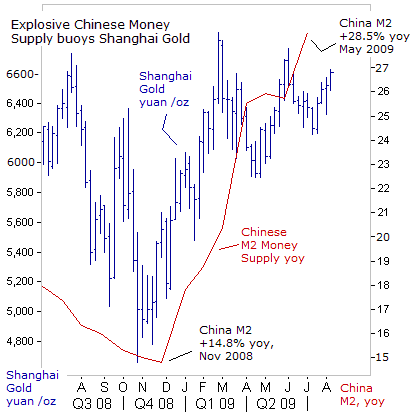
A relatively healthy banking system enabled the Chinese central bank to work its magic. China’s M2 money supply is growing at a record +28.5% annualized rate, and the money supply surge is coinciding with big rallies in stocks and property, spilling over into neighboring Hong Kong. State-controlled Chinese banks extended 7.4-trillion yuan ($1.2-trillion) of new loans in the first half of this year, equal to 25% of China’s entire economy - helping to fuel a powerful Shanghai red-chip rally.

One of the beneficiaries of the explosive growth of the Chinese money supply is the Shanghai gold market, which is trading near 6,600-yuan /ounce, and is also tracking powerful rallies in industrial commodities. China is poised to overtake India as the world’s top gold consumer this year, and there is speculation that Beijing will quietly buy the gold which the IMF wants to sell in the years ahead.

China, the world’s biggest gold mining nation, is seeking to boost gold output by 3% to 290-tons this year, far less than the 400-tons it consumed last year. Thus, China could become an even bigger importer of the yellow metal in the months ahead, helping to cushion inevitable corrections in the gold market. Given the trade-off between expanding growth and fighting asset-price inflation, Shanghai traders are betting that Beijing will opt to blow even bigger bubbles in asset markets.

Industrial Commodities Eyeing Shanghai

China’s super-easy monetary policy is designed to offset the damage to its export-dependent regions, which are suffering from the collapse in global trade. Beijing is also spending 4-trillion yuan on infrastructure projects, equal to roughly 15% of its economic output per year, to create jobs and stoke economic growth. So it was of great interest to global traders, when the Shanghai red-chips suddenly plunged -5% on July 29th, the biggest daily loss in eight-months, on rumors that Beijing would curb bank lending in the second half of this year.
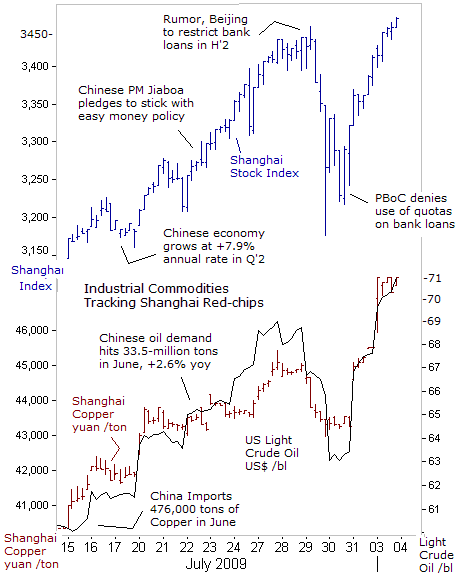
The Shanghai index is prone to sudden shake-outs, with the index trading at 35-times earnings, and Shenzhen’s small-cap shares trading at 45-times earnings. The Shanghai red-chip index has evolved into the locomotive for key industrial commodities, such as crude oil, base metals, and rubber. Industrial commodities rebounded from a nasty one-day shake-out on July 29th, after the People’s Bank of China wasted little time in denying rumors swirling in the media that it was considering the idea of enforcing quotas on bank loans.

The prospects for Chinese corporate earnings growth are of critical importance, with the Shanghai stock index flying higher in bubble territory. Large-scale industrial companies in 22 Chinese provinces saw their profits decline -21.2% in the first half to 894.14 billion yuan, but the decline rate was less from the first quarter’s 32% slide, and nowadays, “less bad,” means signs of recovery.

The most optimistic scenario calls for Chinese industrial profits to rebound to an annualized growth rate of +30% in the fourth quarter, due to the government’s massive stimulus. China’s Bank of Communications predicts the economy’s growth rate will accelerate to a pace of +9% in the third-quarter and +9.8% in the fourth-quarter. China’s crude steel output would surely top 500-million tons this year, equaling 40% of the world’s total production.

Korea Joins Alignment of B-R-I-C-K

Upbeat markets in China are helping underpin the BRIC nations, including Brazil, India, and Russia, which have the four best performing stock markets this year. Brazil’s Bovespa Index is up 79%, India’s Sensex Index is up 63%, and Russia’s RTS Index has gained 62-percent. The S&P-500 Index by comparison, is up 9.4% this year, while Japan’s Nikkei-225 index is up 7.5-percent.

One could add Korea to the alignment of B-R-I-C-K stars, since the Kospi Index has rebounded by 72% above its November low, emerging as the most favored market among global investors. With growing appetites for risky assets, global investors have rushed to snatch up Korean Kospi shares, particularly those in the information technology (IT) and the auto sectors. Foreigners were net buyers of $4.7 of Korean stocks in July, much larger than net-purchases of $2.6-billion of stocks in Taiwan, $1.9-billion shares in India, and $1.29 billion shares in South Africa.
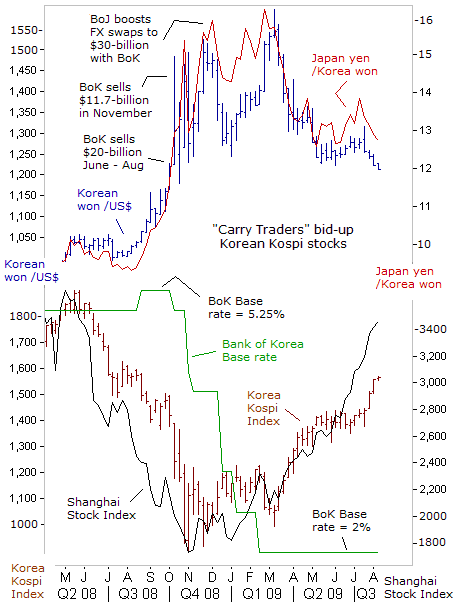
“Money has no motherland, financiers are without patriotism and without decency, - their sole object is gain,” observed Napoleon Bonaparte. Highlighting the fickle nature of speculators, - foreigners bought a record $18-billion of Korean securities in the second-quarter of this year, or 24-times more than $750 million the previous quarter. In the third and fourth quarters of 2008, foreigners sold $17.9-billion and $17.4-billion, respectively, at the height of the global financial turmoil.

Foreign buying of Korean equities knocked the US-dollar 28% lower against the Korean-won, and the Japanese yen has tumbled 20% to 12.8-won, since March 10th, when global stock markets bottomed out. “Carry traders” are active in Seoul, and profiting from a stronger won. In a world where G-7 central banks are pegging rates at record low levels, it does not take much imagination to envision the Federal Reserve, the ECB, and the Bank of Japan underwriting rallies in the emerging currencies of Brazil, Russia, India, and Korea, just as Tokyo pumped massive liquidity straight into New Zealand and Australian dollars during its flirtation with the hallucinogenic drug - “Quantitative Easing” (QE) between 2001 and 2006.

Virtuous Cycle Swings in the Kremlin’s Favor

The resilience of China’s economy has rekindled the de-coupling debate, which hinges on the premise that the emerging economies in Brazil, Russia, India, China, (BRIC) can grow in spite of a declining G-7 economies. The so-called BRIC countries accounted for half of global growth in 2008 - China alone accounted for a quarter, and Brazil, India, and Russia combined equaled another quarter. Furthermore, the IMF notes that BRIC “accounted for more than 90% of the rise in consumption of energy products and metals, and 80% of grains since 2002.”
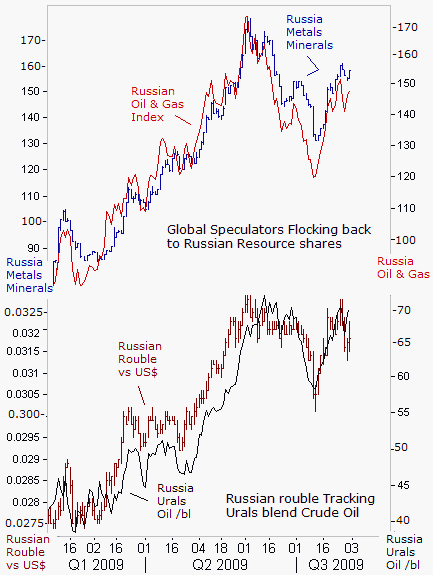
The virtuous cycle of events are now swinging back in the Kremlin’s favor, as global speculators flock back into hard-hit resource shares trading in Moscow. Russia’s central bank cut its main interest rates for the fourth time in less than three-months, after Moscow said the local economy contracted an annual 10.2% in the January-May period. Bank Rossii lowered the refinancing rate a half-point to 11% following on initial reduction on April 24th and two further cuts on May 13th and June 5th.

The Russian rouble has rebounded 16% against the US-dollar, since the first quarter, as Urals blend crude oil rebounded towards $70 a barrel, and base metals surged higher, boosting demand for Russia’s currency, a world leader in commodity exports. Russia is the world’s second-largest oil exporter behind Saudi Arabia, and supplies a quarter of Europe’s natural gas needs. Russia is also the world’s largest nickel and palladium miner, the second largest platinum miner, and the fourth-largest iron ore miner, behind Brazil, Australia, and India.
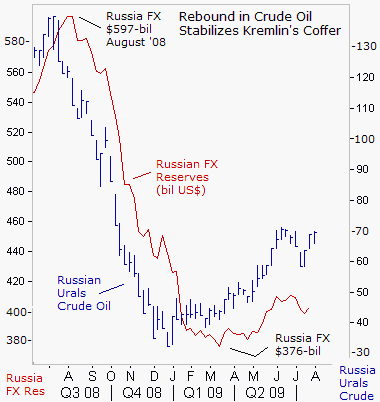
After reaching a record high of $597-billion last August, Moscow’s foreign currency reserves were dramatically depleted in the second-half of 2008, as the central bank spent more than $200-billion supporting the Russian rouble and bolstering the capital position of domestic banks. This year’s rebound in Urals blend crude oil has improved the Kremlin’s coffers, to the tune of $404-billion today. China, the world’s second-largest oil guzzler, imported 3.83-million barrels per day in July, or 25% more than a year earlier, the fastest pace in nearly two-years.

The BRIC nations are rethinking how their US-dollar currency reserves are managed, underlining a power shift from the United States, which spawned the global financial crisis. Russian chief Dmitry Medvedev has repeatedly questioned the US-dollar’s future as a global reserve currency. China is allowing companies in its southern provinces of Yunnan and Guangxi to use yuan to settle cross-border trade with Hong Kong and Southeast Asia to reduce exposure to the US-dollar.

India Weathers the “Great Recession”

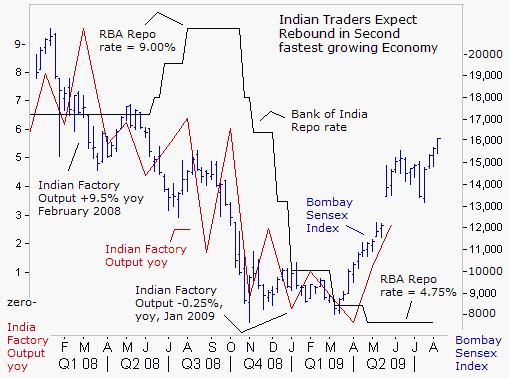
Reserve Bank of India chief Duvvuri Subbarao says India’s modest dependence on exports will help Asia’s third largest economy, to weather the “Great Recession” and even stage a modest recovery later this year. Even during the depths of the October massacre in the Bombay Sensex Index, India managed to maintain a 5.3% growth rate in the fourth quarter, and India’s banking system had virtually no exposure to any kind of toxic asset, manufactured in the United States.

India’s factory output contracted by a slim 0.25% in January, the first decline this decade, and export earnings had fallen for six straight months. In January exports were 16% lower from a year earlier tumbling to $12.3-billion. So the Reserve Bank of India (RBI) scrambled to rescue the Bombay stock market, by slashing its lending rates six times from September thru April, by a total of 425-basis points.

click to enlarge


The Indian Sensex index began to decouple from Wall Street and Tokyo in early May, after it rallied 14% for its biggest weekly gain since 1992, when Indian Prime Minister Manmohan Singh won a second term. Bombay stocks soared with enthusiasm at the prospect that Singh’s new government, shorn of Communists, would privatize up to $20-billion of state-owned assets, increase foreign investment in highly profitable crown jewel companies, begin deregulation of banking and financial services, and gut restrictions on the closing of factories.

India’s factory sector, measured by the Purchasing Mgr’s Index, held strongly at a reading of 55.3 in July, or 2-points higher than China’s, signaling a strong industrial recovery in the second half of this year. If the decoupling of China, India, Russia, and Brazil becomes a reality, it could be good for the developed G-7 nations, as growing wealth in BRIC nations could, in theory, increase demand for goods made in battered nations like Japan, Germany, and the United States.

A decoupling between the emerging BRICK nations and the more developed G-7 economies would mean a huge shift in the global financial markets, away from the traditional pattern of emerging markets dancing to the tune of G-7 economies, which still account for 60% of global GDP. Instead, increasing independence could lead to a greater sphere of influence of the emerging giants, led by Beijing.
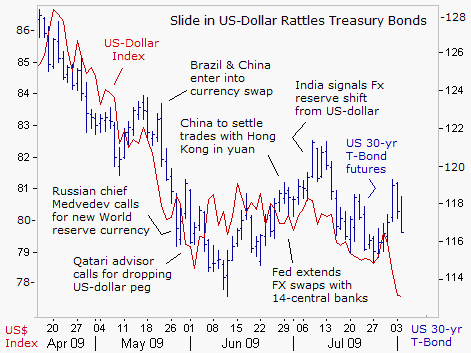
In the United States, Fed chief Bernanke is pumping a “bailout bubble” for Wall Street, similar to the policies of his mentor “Easy” Al Greenspan, who inflated the housing bubble, the sub-prime debt bubble, and the high-tech bubble. It’s a never ending cycle of boom-and-busts of bubbles, engineered by central banks. The revival of the “Commodity Super Cycle,” might already be in motion, and if a global economic recovery gains traction, soaring input costs would begin to crimp the profit margins of the giant Asian industrialists.

All the liquidity that’s been unleashed into the global banking system would play havoc with accelerating inflation. History shows that central banks won’t pre-empt inflation by withdrawing liquidity early. Instead, the money printers tend to inflate bubbles to dangerous proportions. Add to the mix, the vast leverage of the US-dollar and Japanese yen carry trades, it’s going to be a wild ride for the US Treasury bond market, which is increasingly dependent upon the whims of BRICK.

Source: SeekingAlpha, 05.08.2009 by Gary Dorsch

Tuesday, 4 August 2009

Mexico: Too early to be optimistic – August 2009 IXE – Banif Market Analysis

The Mexican economy seems to have hit rock bottom in 2Q09, but a strong recovery will not occur in the short-term. The Mexican Central Bank cut interest rates by 25 bps and should now maintain them at 4.5% for the rest of the year.
The President should suggest more structural changes in the economy in coming months, but expectations are that Congress will not approve them. All measures implemented by the Government during 1H09 (mainly incentives for the construction sector) could reflect positively in 3Q09, with results expected to be a little better. However, GDP should still present a 4.8% drop.

Mexico - Monthly allocation - August 2009

The USA’s 2Q09 GDP, released on last Friday (July 31), came at -1% which is better than market consensus of -1.5%. Although better than expected by market, the GDP composition does not show any consistent and significant improvement. In particular, the consumption of families worsened again after a slight improvement in 1Q09. Therefore, the Mexican economy cannot rely on short-term improvements in its exports to the US and remittance flows, the external market will not improve enough.
Additional Risks
It is important to mention that there are rumors of a risk to Mexico’s credit rating, which could suffer a downgrading by credit agencies.
1H09 seems to have reached rock bottom
Overall, figures in 1H09 seem to have hit rock bottom for both the Mexican economy and companies. However, we do not see any strong recovery in 3Q09 (forecast of a 4.8% drop in GDP) due mainly to its dependency on the US. Therefore, we are suggesting a still more defensive portfolio for August, due to the lack of positive triggers and because of the risk of Mexico suffering a credit downgrade.
Outperforming the IPyC
Stock – Catalysts/Fundamentals
AMXL – reported strong 2Q09 earnings
AUTLANB – strongly laggging the MexBol index
OMAB – discounted in relation to its peers
BIMBOA – good 2Q09 results and expectations are from improvement in the USA
CEMEXCPO– expectations of a refinancing announcement in August
FEMSAUBD – organic growth and increase in sales due to hot weather
GEOB – good 2Q09 results
GMEXICO – expectations are for a favorable judicial decision to its liabilities
GRUMAB – better operational performance than the sector
MEXCHEM –already placed almost 80% of its P$ 2.6 bn capital increase
TLEVISACPO – reducing weight due to higher competition
WALMEXV – still outperforming the sector

Source: Banif-IXE, 03.08.2009

Brazil: No short-term triggers – August 2009 IXE-Banif Market Analysis

We do not see any short-term triggers for the Ibovespa in August. The Brazilian Central Bank should keep the basic interest rates at 8.75% to the end of this year since Copom considers that the current level is consistent not only with the path that inflation should take in 2009 and 2010, but also with the recovery of economic activity. Macroeconomic indicators (employment, industrial production, etc) that showed a slight improvement in 2Q09 should continue their gradual upward trend, but at lower levels than before the start of the financial crisis.

Brazil - Monthly allocation - August 2009

The Government has used fiscal instruments in its economic policies to increase consumer confidence after the crisis. These include the reduction of the IPI (tax) on the automobile, electronics and capital goods industries. Due to the likely extension of these measures, we believe that the sectors most linked to consumption could benefit in coming months.

If, when released, economic data and company 2Q09 results confirm that the crisis has hit rock bottom, or start pointing to a small recovery, they may help the performance of the Ibovespa.
On the foreign front, although US GDP, published last Friday, July 31, came in better than expected at -1%, rather than at market expectation of -1.5%, its composition does not show any consistent or significant improvement. In particular, data on US family consumption worsened again, after a slight improvement in 1Q09. Therefore, we believe the foreign front will continue uncertain.

Concentrated Ibovespa
For the Ibovespa to go up by the end of this year, mining, steel and financial institutions would need to rally, as they carry a heavy weight in the index Petrobras and Vale do Rio Doce alone account for approximately 33% of the Ibovespa. We forecasted the Ibovespa at 48,600 points by December 2009, which leads us to believe that some profit taking will take place by YE. Because of the above points, we reduced the weight of commodity shares in our August portfolio and selected companies that we believe will report good 2Q09 results and dividends.
Outperforming the Ibovespa
Stock – Catalyst/Fundamentals
AMBV4 – Solid market share and volumes
BRTP4 – expectation of reporting a good 2Q09
CTAX4– excellent 2Q09
CPLE6 – discounted shares
ELPL6 – dividends regarding 1H09
GOLL4 – good 2Q09 could reinforce investor confidence
ITUB4 – 2Q09 forecast
JBSS3 – good 2Q09 and gradual recovery
MMXM3 – should be the target of acquisition
PCAR4 – resilience of the food segment
PETR4 – reducing weight in the portfolio
USIM5 – recovery of demand and price in the domestic market
VALE5 – reducing weight in the portfolio

Source: Banif - IXE, 03.08.2009

Sunday, 2 August 2009

Nasdaq OMX ‘closes’ India liaison office

Nasdaq OMX, the transatlantic exchange, has closed its liaison office in India, people familiar with the matter have said. The move comes after failing to list any Indian company on its New York-based exchange since it set up a presence in Bangalore, the country’s information technology hub, in 2001.

One of India’s most senior IT executives, who asked not to be named, said: “Nasdaq has done a lot in terms of educating companies in India but it has been very difficult for them to list companies on their US exchange and therefore it made no sense to keep an office open here”.

Indian IT companies, which contribute to about 25 per cent of the country’s total exports, generating $46.3bn (€32.7bn £27.7bn) in revenues last year, have boomed in the last 10 years providing vital software and back-office services to US and European multinationals.

Nasdaq has been competing aggressively for global listings. However, Kiran Karnik, former president of Nasscom, the Indian software trade body, said the global financial crisis and high regulatory costs in the US had been strong deterrents for Indian groups looking at the US.

He said: “The regulatory environment in the US was perceived [by Indians] as being very high in terms of compliance costs,”.

“I know some companies – that I wouldn’t want to name – who were looking at US alternatives but then decided to list on the London Stock Exchange.”

Ghanshyam Dass, who was appointed Nasdaq OMX’s director for South Asia in 2001, based at the Bangalore liaison office, said he resigned in March this year. He was not replaced locally.

Richard Dour, Nasdaq’s general manager for south Asia, is based outside India. The US exchange group has denied closing its liaison office in Bangalore.

Nasdaq OMX officials in New York, said last week: “Nasdaq OMX has not closed its representative office in India. In fact, Nasdaq OMX’s presence in India is increasing, with multiple representatives serving the region.”

The official added later: “We do not have, nor have we ever had, a physical office in Bangalore – it has always been individual representatives.”

However, in 2001, Nasdaq said in a statement on the company’s website that it had opened an office in Bangalore to service Indian companies. S.M. Krishna, Indian foreign minister and former chief minister of Karnataka, the south Indian state where Bangalore is situated, inaugurated Nasdaq’s liaison office in 2001.

In the eight years Nasdaq was present on the ground, no Indian company was listed on its stock exchange, according to Dealogic and the Nasdaq’s website.

Exchange experts said that there were very few incentives and many regulatory bottle necks for Indian companies to list in the US.

“Indian companies have found cheaper options in raising debt [through] instruments like foreign currency convertible bonds,” said an executive from a local Mumbai-based exchange.

Source: FT, 02.08.2009 by By James Fontanella-Khan and Varun Sood in Mumbai

Saturday, 1 August 2009

How Latin American banks are performing well in the crisis

Latin American economies have felt the effects of the financial crisis, brought on by a global downturn in both demand and capital from the major world economies. The impact for many banks in the region, however, hasn’t been as direct as it has been in other places, in part because they implemented international standards for banking regulation and followed conservative strategies after the regional financial crises of the 1980s and ’90s. McKinsey analyses of the banking sectors in Brazil, Mexico, and Colombia show that these policies should allow them to remain profitable and well capitalized.

Although the economic slowdown has indirectly affected the region’s banks, they will probably remain profitable and well capitalized.

Banks in Latin America are no longer immune to the global credit crisis. True, it’s had little direct impact on them, because they made only limited investments in US and European mortgage-backed securities. Still, a high dependence on exports and commodity prices pushed Latin American economies into recession after consumer spending and industrial production fell in Europe and the United States. As a result, the rate of growth in lending has begun to decline, nonperforming loans are on the rise, and profitability is down.

Nonetheless, McKinsey analyses of the banking sectors of Brazil, Mexico, and Colombia1 show that strong starting capitalization, liquidity, and capital should allow their banks to remain profitable and well capitalized. Before the crisis, foreign securitized assets ranged from 0 to 5 percent of total banking assets in Brazil, Mexico, and Colombia, and domestic issuance of securitized assets was far below that of the United States and the United Kingdom. As a consequence, Latin America was relatively unscathed when the value of these assets dropped precipitously.

Read full article here

Source: McKinsey, 31.07.2009